Baby if I'm the Bottom You're the Top

Unless you lot compete in a market that specifically targets
youth, you probably don't spend a lot of fourth dimension thinking about the emergence of
the and then-called Millennial Generation in America today.
And if y'all don't spend a lot of time thinking near
Millennials, information technology may come as a surprise to yous that at 100 million potent they are
the single largest generational cohort in American history, dwarfing their
predecessors Generation X, and fifty-fifty out-sizing that nearly famous of all
generational behemoths, The Baby Boomers.
"But we don't sell glue or acne cream," y'all may still be
thinking, "so why should we care?"
Consider for a moment the one-half-century long trajectory that
The Boomers have taken from 1960s to the present twenty-four hour period. Those bearded idealists
of the civil rights move are the self same retirees now marching with
placards in the streets protesting for heath-intendance reform. It's not difficult to see
merely how many of the tectonic shifts in civilization and commerce over the last half
fifty years have been powered by the demands of the Boomer generation. From Pepsi's co-opting of Sixties counter-culture, to the
casualization of the workplace, there is a wealth of evidence for how closely linked broad
changes in the American landscape have been to the Boomers moving through time,
like the proverbial egg in the snake.
Millennials are not just a more voluminous generation than
Boomers, only better educated, more self-esteemed, more demanding, more
technologically savvy, more empowered and wired to win at the game of life. And they
are pouring daily by the tens of thousands into the commercial and cultural
mainstream.
In brusk, no matter what business you are in, they are your
next generation of consumers.
Whether 3 years, v, or ten from now, sooner or later
the Millennials will be the ones standing in the grocery isle, or in the bank
managers function, or in the car dealership evaluating your product or service
offering, request "is this for me, really?" More than probable, of grade, they won't
be standing in whatever of these places, but doing it on a voice-activated iPad
while driving to piece of work in Smart Automobile Version three.0, merely you lot get the indicate.
And if you desire a vision of the kind of touch on this
generation tin have on an manufacture, merely look at some of the categories where
they have come up to play already: music– transformed from a big label album-driven model to something and then
customizable and just-in-time that it's barely recognizable as the industry it
in one case was; clothing–the fast fashion of a Forever 21 shattering traditional
"one trade drib per season" models into shards; and of class the
social networking "manufacture," remarkable in then many means, not least of which is
the speed with which a single concern entity tin become from zero to one-half a
billion consumers.
At MTV, of class, youth is our market.

MTV made a determination at its point of inception to never abound
old with the audition but to reinvent periodically for each "generation next."
Then naturally, nosotros have been 1 of the companies impacted starting time and dramatically
by the Millennial generation coming of historic period as entertainment consumers.
Because young people are our viewers and considering they
are so fast and so fickle (and becoming ever more so), we study them with a
deep intensity and intimacy. Nosotros strive to understand not merely the "what," but
also the "why"–their drives (witting and unconscious), desires, passions,
fears, and challenges.
In all of our work with Millennials, we have identified a
series of traits that are quite unique to this generation (versus prior
generations), and which nosotros believe will have dramatic implications on who
they will become as consumers–non just consumers of entertainment,
but of cars, homes, refrigerators, and shampoo.
Earlier describing these principles, it's important to
highlight two tectonic forces that motility below much of what defines the
uniqueness of this generation. The first, and mayhap most important, is the
recalibration of the nuclear family and, as a event, the fashion this
generation was parented.
A century of "parent-centered" nuclear family unit has steadily
been nether-going a paradigm shift,
and may accept just passed the tipping point. The nucleus of the family has been moving
towards the child, and Millennials look like the first generation raised in
that new nuclear family construction. No longer the hierarchical structure with
disciplinarian parent "leadership," the new family unit is flattened to a democracy, with
collective (if not kid-driven) controlling process. Parents are more like
best friends, life coaches, or as nosotros at MTV phone call them "peer-ents."
75% of Millennials in an MTV written report agreed that "Parents of
people my historic period would rather support their children than punish them," 58% agreed,
"My parents are similar a all-time friend to me."
No longer is it necessary to "rebel against" authoritarian
parents to individuate, engage in acts of self-expression, or button at the
boundaries. Equally one youth psychologist we piece of work with pointed out, "Parents don't
say you tin't become to the party, they create condom spaces to consume booze, they
say Can I choice you up afterward?, Here's coin for a taxi."
Self-expression, having your voice heard, following your own
path–these are all values that are positively encouraged in modern parenting
styles. Why insubordinate when you simply need to explicate your behavior in terms of "my
experiment in self discovery."
Per centum of
Millennials who hold with the post-obit statements
(from MTV Millennial Edge
Study, 2010):
• I'm ever expressing
myself in dissimilar ways – 81%
• I hate it when other
people expect me to live by their rules – 76%
• If I want something,
nothing is going to terminate me – 69%
In brusque, the power dynamics of the family unit take shifted
dramatically, and much of the empowered, one could even say "super-powered"
style of the Millennials has its roots in this redistribution.
And in the manner of pouring gasoline on a burn down, the 2d tectonic
shift is technology. The "You Demand Information technology," button, everything costless, always
on culture of technology and the Cyberspace has amplified much of the "social
coding" of the style Millennials were parented. And every bit many commentators have
already pointed out, the revolution will exist tweeted. The power is in the hands
of a one thousand thousand anonymous hands, and can exist wielded apparently consequence free,
in real time, with the click of a mouse.
Based on what we know nigh what makes this generation tick,
and what we hear and observe most them on a daily basis, we have distilled
down five principles, or possibly they would be amend described equally challenges
for businesses thinking about what it will mean to cater to this Millennial
consumer as they come on line in a major way to more and more sectors of
business concern.
1. What
will information technology hateful when co-creation with your consumer becomes function of your business
model?
A generation
raised on "children should be seen and heard" simply will not be a passive
consumer of anything. They will demand a voice in, a stake in, fifty-fifty a artistic
point of view about, everything that your business does–from the production
itself to the style it is sold and marketed, to the social responsibility
policies of the arrangement itself. They may or may non choose to apply that
power (for case only miniscule percentages of people actually contribute to
the oversupply-sourced IP of Wikipedia), but they will demand that the mechanisms
are in place that give them the choice to participate and the feeling that
co-inventiveness drives the evolution process.
And this probably won't be a erstwhile outcome ("lets go and practice
some creative focus groups and get our audition to help usa think about
innovation"). It will be an on-going existent time feedback loop with demonstrable
bear on and validation built in. One of the most buzzed almost advert campaigns of
the concluding few years is Erstwhile Spice, where real time changes happen in the
commercial artistic as a result of input from the audience. In that location's the beauty
of the idea itself, and and so at that place's the power of the feedback/validation loop
created with the audition–"Meet, yous matter, your vote counts, your touch is
felt and something moves as a consequence, you are smart and creative and you have … power."
And speaking of smarter …
ii. What
volition it mean to make your product ten times smarter than information technology is today?
In all the inquiry nosotros conduct with this generation at MTV,
the word we perhaps hear the nigh is "smart" (closely followed by "random,"
"awkward," "awesome," and "dearest"). "Smart" means a multitude of things to the
generation, only 1 thing that'due south common is that it carries a very high premium
and social currency. For the most educated generation in history, told past so-called "velcro" parents that smart is
everything, it should hardly exist a surprise. And indeed 57% of the generation
consider themselves smarter than their parents, and 68% agree that "Nerds are
the new jocks"!
Nosotros already accept the Smartphone, the Smart Motorcar and even Smart
Water. What is smart soap, smart diapers, smart gas stations.
When you investigate the concepts of smartness further with
the generation, some of the nuances that emerge give fascinating insights into
their collective psyche. For something to be "smart" information technology has to, for example, entertain
me, remember what I do and anticipate my needs, do "everything" for me, accept
born complexity and layers of meaning, shape-shift, be as smart as me!
3. What
will it mean to exist in a "2 player game" with your consumer?
Millennials have a natural predisposition to view situations
in terms of the metaphor of a game. Take the workplace–"what are the rules of
this globe, what are the levels, how exercise I become to the 10th one every bit
chop-chop as possible (that nice CEO suite on the corner of the top floor), is
there a shortcut, a smart bomb, a hugger-mugger archway, a magic potion?" Square,
the location-based social networking site, literally turns 1'due south social life
into a game complete with badges, medals, trophies, and even mayor-hood awarded
to "players."
The generation learned immature and learned well how to
expertly negotiate with their parents to get a pass out of homework or a day
off school … power-players in the game called "family." Raised on a nutrition of nearly millions of hours of World Of
Warcraft, elaborate earth kid-centered "constructs" like Harry Potter, and
soccer trophies for the whole team, Millennials want to win.
Asked virtually "worldview" based on the following phrases, the
intergeneration differences hither become quickly apparent.
"Game" the system:
Millennials – 53%
Boomers – 26%Protest the system:
Millennials – 13%
Boomers – 59%
Marketing to this generation may be more similar a two histrion
game, where anybody'south looking for the win win. How will your campaigns create
a sense of "play" on the part of the audience, a sense of depth and levels, a
sense of engagement, a validation loop, and ultimately a sense of material and
emotional victory (or fifty-fifty of being the special i that figured out how to
game it )? In the marketing entrada for Halo 3, level after level of depth was
cached inside layers of the marketing entrada, consumers freeze-framing DVR
playback of commercials to option up codes embedded in the picture to follow
breadcrumbs down Internet wormholes for the next clue.
4. What
will it mean to your business to operate in on-going versions rather than a
final product?
If we had to identify someone who is the face up of the
Generation, the way that Bob Dylan perhaps was for the Boomers or Kurt Cobaine
for Xers, then today that face would be Lady Gaga's. Considered across doubt the "most interesting
person today" by the generation the core feature of Gaga is the speed
and ferocity of her cocky-reinvention. She is doing in 10 minutes what it likewise
Madonna x years to reach.
Who do you think is the well-nigh interesting person in pop culture today?
Size of give-and-take indicates book of response:
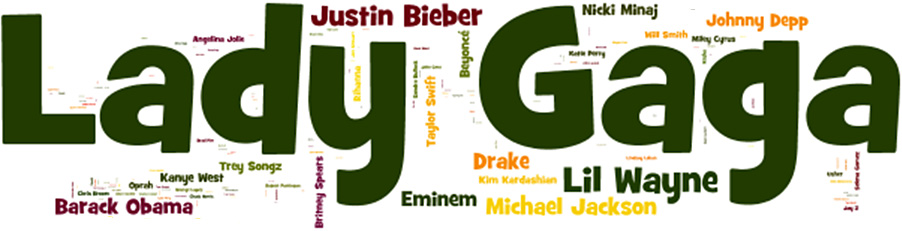
The parental premium placed on self expression for today's
kids, combined with technology tools to literally "curate the self" in real
time, has created an insatiable appetite for newness. If something does not
version, it quickly becomes tiresome. This has e'er, of course, been the
consumer demand that drives every company'south innovations engine, simply the requisite
rpm of that engine is rapidly going into the red zone as this generation come
on line as buyers. It's no longer acceptable, for example, that chewing gum
remain the same season throughout the duration of the chew. No, the gum has to
flavor-shift mid chew lest the chewer's dopamine/adrenaline cycles kickoff to
fade and new stimulus is required.
v. What
will it hateful when in that location is no such affair as an un-connected product?
Everything we are learning about the generation points to a
need to exist constantly continued, existentially uncomfortable with the feeling
of being "alone," experiencing a fear of missing out when they stray to the hinterlands
of their social graph. 1 interesting piece of research led us to understand
how the automobile, so squarely a symbol of freedom and independence for prior
generations, has become in danger of being perceived every bit a "disconnection
device" for Millennials. "Trapped" within the hermetically sealed vehicle, "lone",
and of course unable to text and cheque your status update, the feeling of the
open road becomes the very antithesis of freedom, more like isolation.
A product which is 'un-connected' has a certain inertness
for the generation. At the more superficial level even the most inert production
can build a web site and "connect". Simply it is much more challenging to
re-imagine your production experience by asking how to increase its innate
connectedness. What would a connected retail experience wait similar? Perhaps similar
the and then chosen "booty video" syndrome where kids motion-picture show themselves in changing rooms
trying out different outfits, post the film of their ensembles in real time,
and seek feedback from their social network on which ones expect best earlier
purchasing.
As the onetime hockey adages goes, yous don't skate to where the
puck is, yous skate to where it's headed. And in the example of the Millennials,
we're looking at a hundred million pucks moving towards open water ice where bold,
as-still-unimagined products and services will some twenty-four hours look them. So heads-up, hither come the Millennials.
Nick Shore is Senior Vice President of Strategic Consumer Insights and Research at MTV. He is responsible for all of MTV'southward inquiry efforts across MTV, MTV2, mtv.com, mtvU, and MTV Tr3s platforms.
Baby if I'm the Bottom You're the Top
Source: https://www.fastcompany.com/1742592/are-you-m-ready
0 Response to "Baby if I'm the Bottom You're the Top"
Post a Comment